
TripBox
Two-sided travel platform: travellers plan multi-destination trips with AI-generated itineraries and multi-currency settlement, agencies run branded client operations on the same engine.
- Role
- Solo — architecture, backend, interface, design system
- Period
- 2025 — Present
- Type
- Platforms
- Status
- production
- 515k
- Lines of TypeScript
- 418
- API routes
- 50
- Feature modules
- 500
- Test files
Showcase
Overview
Serious trip planning is a spreadsheet-and-tabs problem: fragmented, error-prone around money and dates, painful to share. TripBox makes the hard parts — currencies, splits, multi-leg transport, group permissions — precise, and puts an AI planner on top that has to respect real opening hours and real travel times.
It is two products sharing one engine. Travellers get the trip builder, the day boards and the settlement maths. Travel agencies get a console on the same data: branded client-facing storefronts, lead and commission management, payment plans and DMC settlement. The B2B surface is the consumer app with more power, not a bolted-on enterprise panel.
The codebase is 50 feature modules with hard boundaries over a Supabase Postgres database, 418 API routes, and roughly 515,000 lines of TypeScript.
Architecture
System architecture
Scroll to pan
Itinerary generation
Scroll to pan
The expense ledger
Scroll to pan
A mutation with no signal
Scroll to pan
Screens
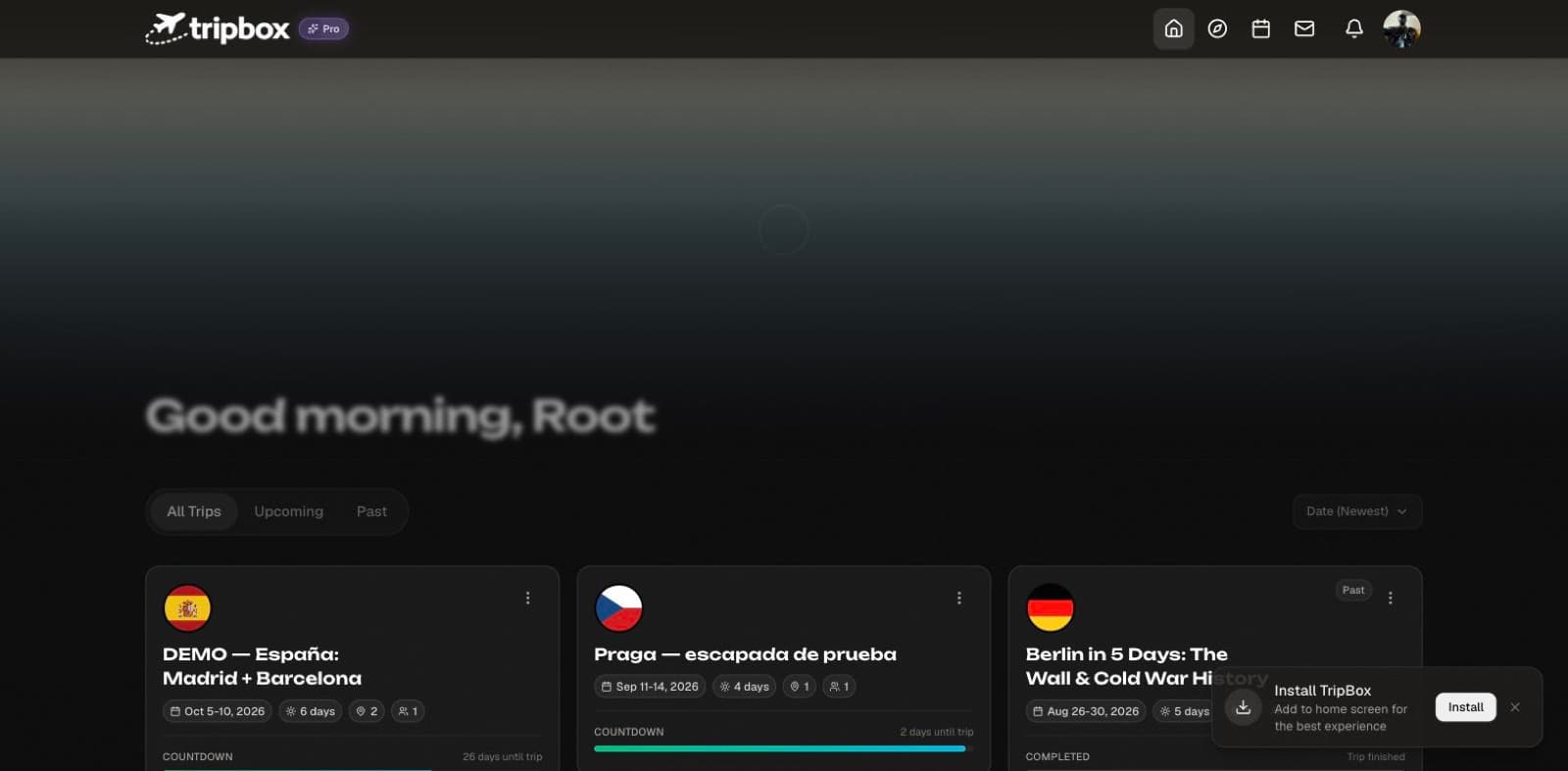
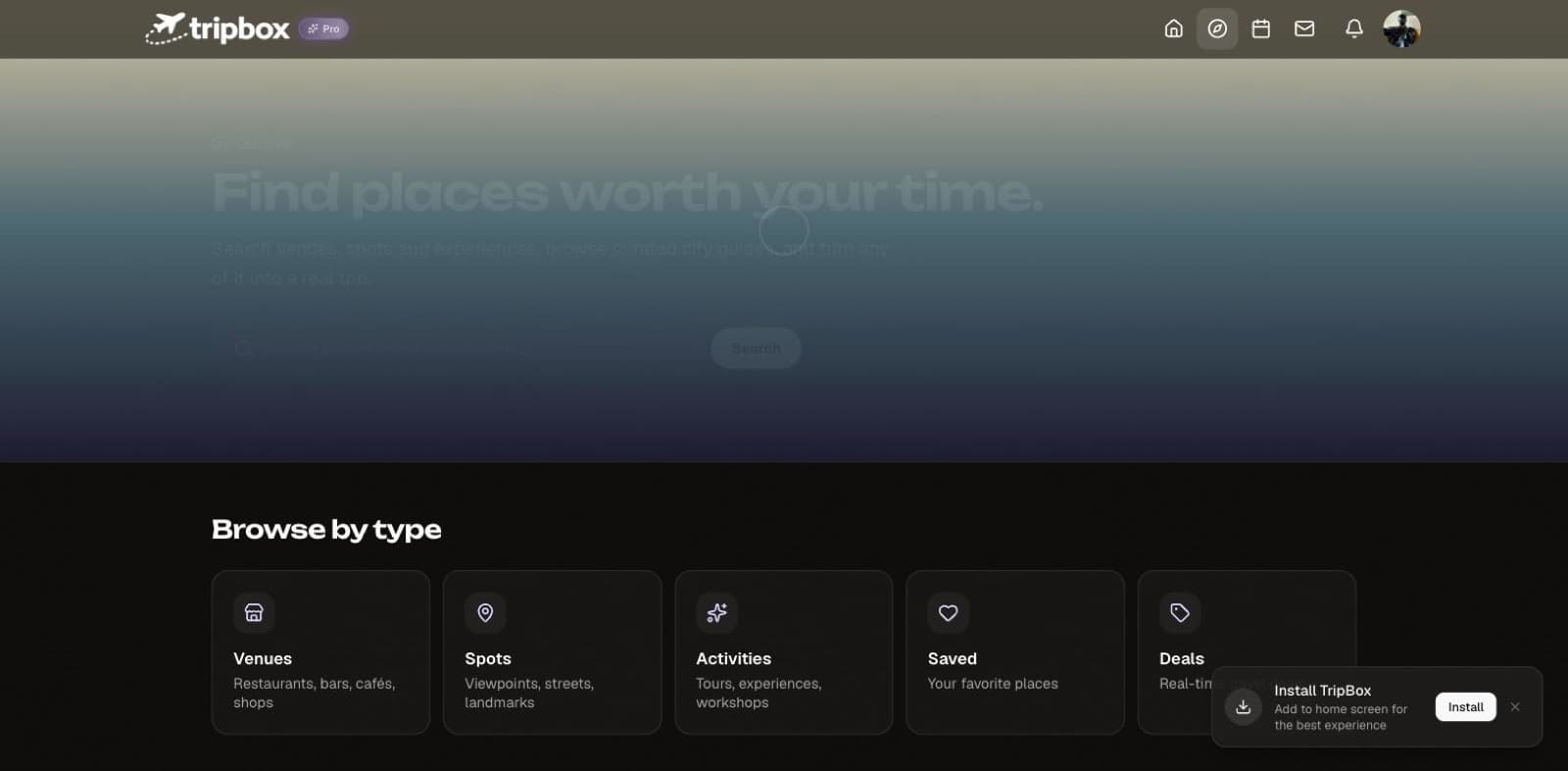
Modules
Trip & itinerary
The spine of the product: a trip is destinations across dates, and an itinerary is what actually happens on each of them.
- Day boards turn a date range into plannable units
- A master timeline reconciles transport, stays and activities
- Day trips nest a smaller plan inside a larger one
- Per-day checklists and events
Destinations
A curated database of places, plus the discovery surfaces that turn browsing into an actual plan.
- Venues, spots and activities as first-class records
- City guides and editorial destination content
- Search, explore and discover surfaces
- A save-to-trip layer that bridges discovery and planning
Transport & stays
Everything that moves the traveller or houses them, modelled properly rather than as free text.
- Flights with explicit layover modelling
- Accommodation, rentals and tours
- Distance and travel-time calculation between points
- Booking records with document storage
Cost & budget
A three-layer budget system where the numbers have to be trustworthy enough to replace a spreadsheet.
- Expenses stored in the currency actually paid, with the rate at the time
- Cost splitting across travellers
- Settlement between companions at the end of a trip
- Budget allocation and spend analytics
AI planning
Claude generates the itinerary, and a validation pipeline stops it producing plans that only work on paper.
- Day-by-day generation constrained by opening hours and travel time
- Re-planning on change instead of regenerating from scratch
- Trip import from external sources
- Recommendation and city-intelligence surfaces
Maps & 3D globe
Two levels of geography: a Three.js globe for the shape of a journey, Mapbox for the street it happens on.
- Interactive globe as the logged-in home surface
- Mapbox GL for street-level detail and routes
- Marker clustering across the venue catalogue
- Route visualisation between destinations
Agency console
The B2B layer: travel agencies and DMCs running their client-facing business inside TripBox, under their own brand.
- Branded client-facing storefronts per agency
- Client, lead and commission management
- Payment plans and DMC settlement
- Argentine tax handling, including percepciones
Collaboration
A trip is usually a group activity, so permissions, notifications and shared state are core rather than optional.
- Invitations with per-trip permissions
- Notifications and activity feeds
- Gamification — challenges, badges, leaderboards
- Social and profile surfaces
Offline-first sync
People plan trips on planes and in places with no signal, so mutations survive a dead connection.
- Server-side idempotency wrapper on mutations
- Pending-sync state surfaced in the UI
- Conflict-safe edits
- Installable PWA with offline routes
MCP server
TripBox exposes itself to AI assistants as a set of typed tools and resources — the product is agent-addressable, not just a website.
- Registers agent tools and resources with typed output schemas
- An assistant can read and write real trips
- Same surface I use to plan from a chat window
- Scoped to the authenticated user
Engineering
AI output that survives contact with reality
A generated itinerary is worthless if it schedules a museum at 3am or teleports you across a city in ten minutes. The generation pipeline constrains Claude with opening hours, real travel time between points and traveller preferences, then validates the result before it ever reaches the UI — and re-plans on change instead of regenerating the whole trip.
One design system, two audiences
The consumer app and the agency console share a single language. That constraint is written down in a product brief the code is checked against, because the easy failure mode is a beautiful traveller app bolted to a grey enterprise panel.
Money that stays honest
Expenses are stored in the currency actually paid with the rate at the time of spend, so historical totals do not drift when rates move. Splitting and settlement are computed from that ledger rather than from a running total, which is what makes the numbers trustworthy enough to replace a spreadsheet.
Mutations that survive no signal
Trips get edited on planes. Mutations go through a server-side idempotency wrapper and a client queue, so a retry after a dropped connection does not double-book a hotel or duplicate an expense.
AI harness
TripBox is built with its AI harness committed to the repository. The product identity, the design system and the safety rails are machine-readable, the agents that touch the code are specialised by role, and design findings are re-verified against the source before anyone acts on them.
Machine-readable product brief
PRODUCT.md defines the register, both audiences, brand personality, explicit anti-references and design principles. DESIGN.md carries the token spec — an OKLCH palette, type ramps, spacing. An agent designing a surface reads the same brief a designer would be handed, so output stays on-brand without me re-explaining it every session.
- PRODUCT.md
- DESIGN.md
Nine specialised subagents
code-reviewer, test-runner, refactorer, db-migrator, bug-fixer, seed-curator, pr-creator, feature-builder and visual-tester. Each has its own brief and tool scope, so a migration agent cannot wander into UI work and a reviewer cannot quietly rewrite the thing it is reviewing.
- client/.claude/agents/
Thirteen role briefs
tech-lead, frontend-lead, backend-lead, security-lead, qa-engineer, ux-specialist, content-lead, domain-expert, mapbox-specialist, marketing-seo and documentation roles. These are perspectives rather than executors — they define what a given kind of reviewer should care about before it reads a line of code.
- client/.claude/workers/
Project skills, with a lockfile
Bespoke skills for the repetitive work — seo-content-country, seo-content-trip, migrate-db, spec-epic — authored against a shared template so new ones stay consistent. External skills are pinned in skills-lock.json by source and SHA-256, so a third-party skill cannot change under me between runs.
- client/.claude/skills/
- client/skills-lock.json
Design pass on a post-edit hook
A design-critique skill is wired to fire after every edit, create and patch through a postToolUse hook, with a live browser session for iterating on a surface in place. Design review happens as code is written rather than in a separate round nobody schedules.
- .github/hooks/impeccable.json
- .github/skills/impeccable/
Adversarial verification passes
Nine verification groups where every reported defect is re-checked against the actual source: confirmed or downgraded, with file, line, and a written reason. A P1 accent-drift claim gets demoted to P2 when it turns out to be purely aesthetic. It is the step that keeps AI review from generating confident noise.
- verify-trip-builder.json
- verify-pipeline.json
- verify-dashboard.json
MCP in both directions
The Supabase MCP server lets an agent read the real schema instead of guessing at it. In the other direction, TripBox ships its own MCP server so an assistant can operate real trips — the product is a tool an agent can use, not just a site a human clicks.
- .mcp.json
- client/modules/mcp/
Guardrails written as rules, not hopes
CLAUDE.md opens with a table of forbidden database commands and their safe alternatives, a hard ban on native browser dialogs, and a rule that every image must be uploaded to Storage — with a validate step that fails on any external image URL, because that failure had already shipped blank cards to production twice.
- client/CLAUDE.md
Typecheck and migration gates
GitHub Actions run typecheck and check database migrations on every push, with a separate workflow for pushing them. Agents move fast; CI is what makes that safe rather than reckless.
- .github/workflows/
Stack
- 01Next.js
- 02React 19
- 03TypeScript
- 04Supabase
- 05Claude AI
- 06Mapbox GL
- 07Three.js
- 08TanStack Query
- 09Remotion
- 10Playwright
- 11Vitest